Article about Spanish Franciscan nuns raising and conserving the endangered Spanish giant rabbit at their convent.
Toledo, Spain — April 23, 2026
This story was originally published April 23, 2026.
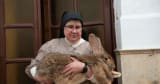
Sr. Consuelo Peset Laudeña's morning routine is not what one would typically expect from an abbess. Before prayers and breakfast, she heads to inspect, one by one, cages housing 35 giant rabbits and their young inside the Convent of St. Anthony of Padua in Central Spain. At 54, Peset leads the group of Franciscan sisters who have taken on the mission of conserving Spain's giant rabbit, a breed in danger of extinction. This breed is not only a genetic heritage belonging to Spain but also part of the country's historical memory, the abbess said: During the Spanish Civil War and the postwar period, raising them was crucial to feeding families and orphanages in times of scarcity. "Many families have managed to get by thanks to this animal, and now it seems we are forgetting that part of our history," she told Global Sisters Report.
'We have to protect creation.'—Sr. Consuelo Peset Laudeña Tweet this
Peset said that in Spanish regions such as Valencia, Madrid and Asturias, numerous farms kept up to 300 breeding females, which made it possible to feed a large number of people, especially those orphaned during the war. The breed, a cross between the Flanders Giant and Spanish brown-type females, can weigh up to 20 lbs. and has a high reproductive capacity, as each female can bear up to 22 pups per month. Maricarmen Pleite Orozco, a volunteer at the convent, recalled having tasted meatballs made of rabbit's meat and described it as white, juicy and very flavorful. According to data from the Interprofessional Organization for Farm-Raised Rabbit Meat, rabbit meat is lean, rich in protein, and contains high levels of phosphorus, selenium, potassium and vitamins — qualities that help prevent childhood obesity, anemia in adolescents, high cholesterol and gout.
Raising the animals at the convent began more than 30 years ago when Peset's parents