

Edward Hopper, “Gas”: solitude by the roadside… and the foreshadowing of the oil crisis
artprice.com ↗Article exploring Edward Hopper's painting 'Gas' and its themes of solitude and early signs of the oil crisis.
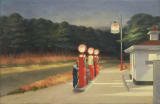
Painted in 1940, Edward Hopper’s Gas is today one of the most iconic images of motorized 20th-century America. This scene of a lonely gas station at twilight—now housed at the Museum of Modern Art in New York—uncannily anticipates the issues and anxieties surrounding oil that would shape the decades to come. A symbol of the automobile age Gas (often translated into French as Essence) is an oil on canvas painted in 1940, measuring about 66.7 × 102.2 cm. Edward HOPPER (1882–1967) depicts a gas station along a country road at the edge of a dark forest, with a lone attendant busy adjusting or closing one of the red pumps. The artist builds the scene from several stations he observed during his travels, recomposed into a single, almost unreal location. The white building, the Mobil Pegasus logo, and the row of pumps are bathed in a harsh artificial light that contrasts sharply with the fading daylight and the deep shadow of the woods. A frontier between nature and fossil energy Many scholars emphasize that Edward Hopper stages a true threshold between two worlds. On one side, nature: a curtain of dark trees closing the horizon, a road vanishing into the woods, an eerie dusk atmosphere. On the other, the gas station: rational architecture, advertising signage, fuel pumps, electric light—all symbols of a civilization built on oil. The station appears as a “last human outpost” before the road plunges into darkness, marking that fragile tipping point between nature and technological modernity. This visual opposition between the bright, artificial light of the station and the forest’s encroaching darkness already evokes the fragility of a lifestyle dependent on an extractive resource. Solitude, dependence, and energy vulnerability Edward Hopper is often described as the painter of solitude and isolation in modern America. In Gas, a single attendant stands beside the pumps, lost in thought, with no customer or vehicle in sight. This total absence of movement re